
You're facing a familiar Alberta landlord problem. The property is decent, the rent is set, and the next move matters more than the last one did. The wrong manager can turn a solid rental into a source of stress through slow leasing, weak screening, poor reporting, or avoidable compliance issues. The right one protects the asset, keeps tenant issues moving, and gives owners a clear view of what's happening on the ground.
Choosing what to look for in a property manager is easier when the conversation stays practical. For Calgary, Edmonton, and Red Deer owners, the best interview questions are the ones that expose systems, local knowledge, and follow-through. Alberta's rental environment rewards managers who understand the Real Estate Act, the Residential Tenancies Act, local bylaws, and day-to-day operating discipline. It also rewards owners who ask better questions before signing anything.
Table of Contents
- 1. Alberta Licensing and Regulatory Compliance Expertise
- 2. Transparent Financial Reporting and Rent Collection Systems
- 3. Comprehensive Tenant Screening and Selection Process
- 4. Proactive Maintenance Coordination and Cost Control
- 5. Local Market Knowledge and Strategic Pricing Guidance
- 6. Professional Listing Presentation and Marketing Strategy
- 7. Proactive Communication, Accessibility and Remote Owner Responsiveness
- 8. Inspection Protocols and Property Condition Documentation
- 9. Lease Preparation and Tenancy Document Expertise
- 10. Track Record and Professional Credentials
- 10-Point Property Manager Comparison
- Making Your Final Decision with Confidence
1. Alberta Licensing and Regulatory Compliance Expertise
A manager can sound polished in a sales meeting and still be a weak compliance operator. That's a problem in Alberta, where owners need someone who understands licensing under the Real Estate Act, plus the practical rules under the Residential Tenancies Act for notices, deposits, documentation, and tenancy termination.

A capable manager serving Calgary, Edmonton, or Red Deer should be able to explain how they handle notice periods, deposit handling, and eviction steps without sounding vague. They also need to account for municipal bylaws and city-specific practices, because provincial law alone doesn't solve every operational problem. For owners, that means the first question is simple, is the licence current, and can the manager prove it through the proper Alberta regulatory channel?
Practical rule: a confident manager answers compliance questions with process, not slogans.
Ask for recent examples of how they handled a difficult tenancy issue, then listen for detail. Strong operators can describe how they document notices, track deadlines, and keep owners informed when a situation escalates. Weak operators talk around the issue or rely on reassuring language instead of clear steps.
- Verify licensing directly: Confirm the manager's current status before any agreement is signed.
- Test real scenario knowledge: Ask how they handled a recent Residential Tenancies Act issue.
- Check their update habit: A good manager tracks legal changes and tells owners what changed.
- Request their compliance framework: Documentation and audit procedures should be available, not improvised.
The point isn't to find a manager who quotes legislation like a lawyer. The point is to find one who protects the owner from avoidable mistakes and knows when to slow down and document properly.
2. Transparent Financial Reporting and Rent Collection Systems
Money is where weak management shows up fastest. Owners don't just need rent collected, they need clean reporting, visible disbursements, and a system that makes it obvious what came in, what went out, and what remains pending.
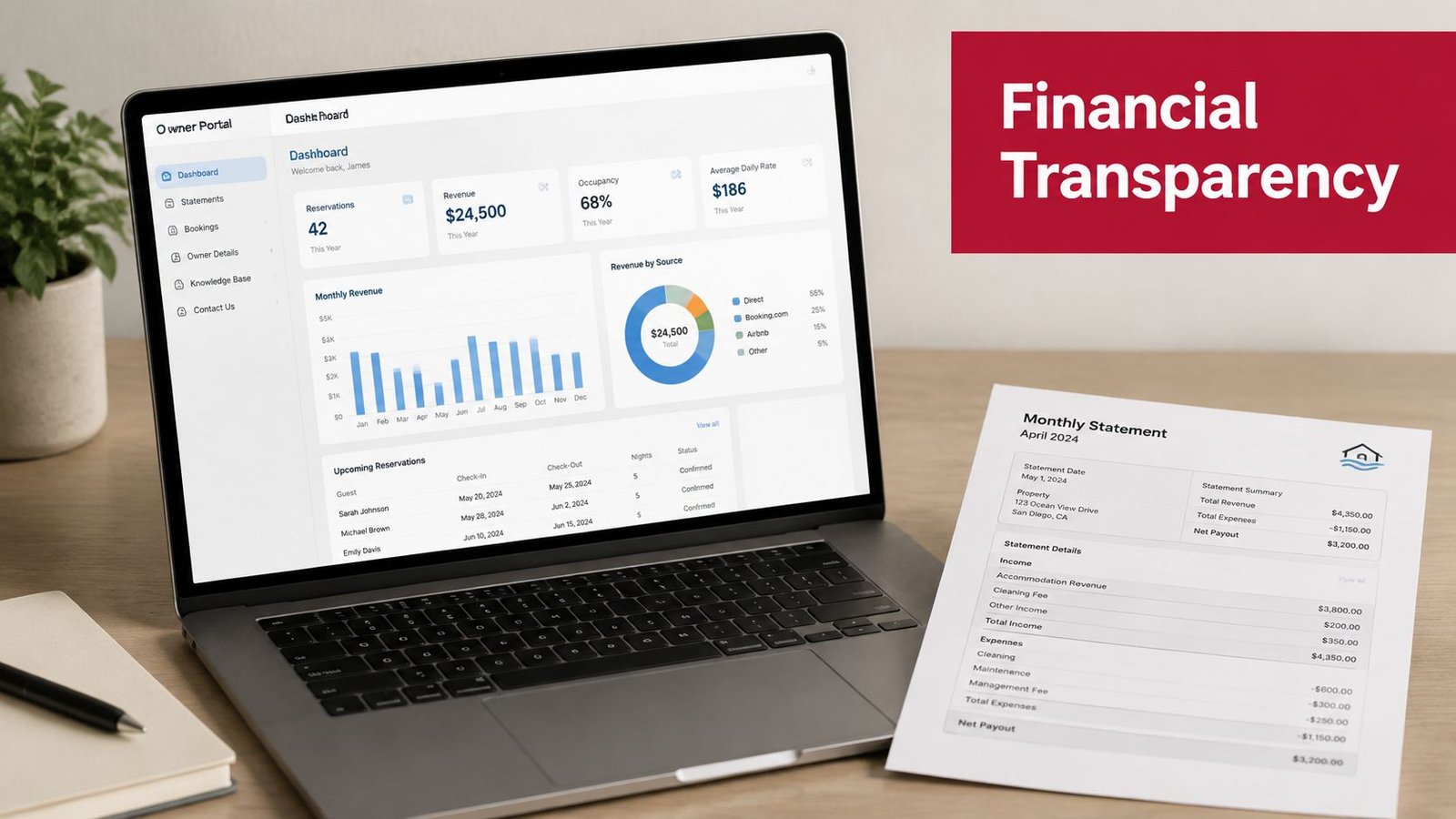
A professional manager should be able to show sample owner statements that are readable and complete. That includes rent collections, maintenance charges, disbursements, and owner proceeds. In Alberta, trust accounting expectations matter, so the reporting process needs to be disciplined, not casual. If the owner portal is clumsy or the accounting explanation is vague, that's a warning sign.
The industry is already mature enough to support proper systems. U.S. property management revenue reached $119.8 billion in 2023, with estimates of $119.1 billion in 2024 and a projected $123.502 billion in 2025 (property management industry statistics). That scale supports professional-grade accounting, and owners should expect it.
A stronger manager will also explain how rent collection is automated, how arrears are flagged, and how late-payment communication is handled. For out-of-province owners, the ability to review records in real time is especially useful. If a manager says everything is “handled internally” but can't show the workflow, the owner is being asked to trust black-box accounting.
3. Comprehensive Tenant Screening and Selection Process
Good tenants are chosen, not hoped for. A manager's screening process tells an owner a lot about future vacancy risk, maintenance risk, and how much time will be lost dealing with avoidable issues.
Tenant screening should go beyond a quick application review. Strong managers check credit, verify income, confirm employment, contact rental references, and assess background information in a way that stays consistent and fair. The best ones can explain how they adapt screening for self-employed applicants or gig-economy earners without lowering standards.
Clear screening standards protect the property, but they also protect the owner from inconsistent decisions.
Managers serving Alberta properties also need to stay aligned with human rights obligations and fair housing practices. That matters because screening isn't just about choosing the strongest applicant on paper. It's about using a lawful, repeatable process that treats applicants consistently and still helps the owner select a reliable tenant.
Ask the manager to walk through one actual decision. How did they handle a borderline credit file, what did they do with limited employment history, and how did they weigh rental references against income proof? If they can't answer clearly, screening may be more cosmetic than real.
A useful way to interview a manager is to ask for the minimum standards they use, then test whether those standards are applied the same way every time. A manager who is too rigid can miss great tenants. A manager who is too flexible can fill units quickly and create more turnover later. The right balance is disciplined, documented, and consistent.
4. Proactive Maintenance Coordination and Cost Control
Maintenance is where property management becomes operational, not theoretical. Owners need someone who can move a repair from complaint to resolution without letting delays damage tenant satisfaction or property value.
The best managers build relationships with dependable contractors and know which jobs need speed versus which jobs need quotes. They track work orders, document repairs with photos and invoices, and use approval thresholds so owners aren't surprised by unnecessary spend. Preventive maintenance matters too, because it reduces the number of urgent calls that become expensive by default.
A manager who controls maintenance well should be able to explain the difference between tenant-requested repairs and owner-initiated upgrades. They should also spell out who authorizes after-hours emergencies and what the escalation path looks like. If they say they “just take care of it,” ask how the owner is kept informed before the invoice arrives.
For Alberta landlords, vendor quality matters as much as pricing. A low bid can become expensive if the contractor misses the core issue or creates repeat work. A strong manager balances responsiveness, documentation, and cost discipline. That's especially important in older Calgary and Edmonton housing stock, where small problems can become larger ones if they're ignored.
A practical interview question is whether the manager can show recent invoices and explain why each repair price made sense. If they avoid that conversation, the owner may be headed for cost creep.
5. Local Market Knowledge and Strategic Pricing Guidance
A manager who knows the street-level market is worth more than one who only knows broad rent averages. Calgary, Edmonton, and Red Deer each have their own tenant demand patterns, seasonal timing, and neighbourhood-level quirks, and the wrong price strategy can leave a unit sitting.
The best property managers use local comparables, not guesswork. They should be able to explain how they price a new listing versus a renewal, what comparable properties they reviewed, and how often they revisit the number if the unit isn't getting traction. For a landlord, that's where a manager's judgment becomes visible.
One useful benchmark for technical pricing discipline comes from market-data usage. A peer-reviewed AEA study of short-term rental property managers found that adopting a market-data intelligence platform was associated with a 22.9% increase in occupancy, 525% increase in average daily price, and 289% increase in revenue (AEA conference paper). The numbers come from a different segment, but the lesson transfers directly, managers who use local pricing intelligence make better timing and pricing decisions than managers who rely on instinct alone.
Ask for the most recent market analysis for the exact property type and neighbourhood. Then ask how often the data gets refreshed and what local indicators they monitor, such as employment, migration, and housing costs. If the answer is vague, the pricing strategy probably is too.
For owners wanting a deeper sense of portfolio strategy, property investment properties guidance from Dreamhouse Realty Ltd. can help frame how rental pricing fits into longer-term holding decisions.
6. Professional Listing Presentation and Marketing Strategy
A vacant property needs to look worth showing before anyone books a visit. Good managers treat listing presentation as a leasing tool, not a decorative extra.
Professional photos, clear copywriting, and multi-channel advertising can materially change who applies and how quickly the property gets attention. Managers should be able to show recent listings that present the unit accurately but attractively. If the photos are dark, cluttered, or inconsistent, that often reflects the same standard they bring to the rest of the file.

Managers should also explain how they handle showings. Are they coordinated efficiently, or are they left open-ended and messy? Are inquiries tracked, or does the manager just hope someone follows up? A serious operator manages the process so qualified tenants move from interest to viewing to application without falling through the cracks.
If the property has condition issues or weaker curb appeal, the marketing plan matters even more. A strong manager won't pretend the unit is perfect. They'll present it cleanly, set expectations properly, and position the listing transparently so the right applicants respond. That approach usually works better than overpromising and dealing with disappointment later.
Good marketing doesn't hide reality, it frames the property well enough that qualified renters keep reading.
Owners should ask whether professional photography is included or priced separately, and how often listings are refreshed on active platforms. If the manager can't explain the workflow, the vacancy period may become longer than necessary.
7. Proactive Communication, Accessibility and Remote Owner Responsiveness
A property manager can be competent and still be a poor fit if communication is inconsistent. For Alberta owners who live out of province, or don't want daily interruptions, predictable communication is essential.
The manager should define how often owners receive updates, what channel is used, and what counts as an urgent issue. They should also explain who covers the property when the primary contact is unavailable. Backup coverage sounds basic, but it matters when a tenant has a late-night issue or a contractor needs an immediate answer.
The North American market already expects digital systems. A National Apartment Association survey cited by Fortune Business Insights found that 68% of property managers in North America use property management software (Fortune Business Insights). For Alberta owners, that means spreadsheets and fragmented tools are a real warning sign, not a charming sign of small-business simplicity. Cloud-based portals are now the normal baseline for rent collection, reporting, maintenance tickets, and owner access.
Ask how emergency approvals work, especially for repairs that need immediate action. Also ask for references from remote owners. If another landlord can confirm that the manager runs the property without constant prompting, that says more than a polished pitch ever will.
For owners who need a stronger remote-oversight model, property management in Alberta for remote owners from Dreamhouse Realty Ltd. is a practical reference point for evaluating how local management supports distance-based ownership.
8. Inspection Protocols and Property Condition Documentation
Inspection work is where a manager proves they care about the file, not just the lease. Good documentation protects the owner in disputes, supports security deposit handling, and catches maintenance issues before they get expensive.
Routine inspections and move-out inspections should be documented with photos, written notes, and checklists. The manager should be able to show how reports are stored, how tenants receive copies, and how tenants can respond if they disagree with a condition note. That process matters because it makes deductions and damage claims more defensible later.
A weak inspection system often shows up in small ways first. Photos are missing. Notes are too brief. Move-in records are inconsistent. Then a tenant leaves, and the owner has little evidence to support a claim. Good managers avoid that mess by treating condition documentation as part of the operating system, not an afterthought.
Ask how often inspections occur and what triggers extra visits. Ask how they separate normal wear and tear from real damage. Ask when the move-out inspection is completed and how quickly the deposit process moves afterward. Those questions force the manager to show whether they understand both operations and evidence.
Owners should also ask how inspection findings are communicated. A manager who writes a useful report but never tells the owner what it means is only doing half the job.
9. Lease Preparation and Tenancy Document Expertise
A lease is more than a form. It's the document that defines expectations, allocates risk, and sets the tone for how the tenancy will be managed.
A capable property manager should draft clear, enforceable leases that fit Alberta requirements and are supported by proper move-in documentation, security deposit receipts, and record retention. The lease should not be a generic template pulled from somewhere and left untouched for every situation. Good managers know how to adjust for pets, roommates, partial-term arrangements, and other details without weakening the agreement.
For Alberta owners who want to review a practical example, this rental lease agreement example from Dreamhouse Realty Ltd. is a useful reference for the kind of structure a manager should be able to explain. The important point isn't copying that format exactly. It's seeing whether the manager can describe what belongs in the lease and why.
Ask how often their leases are reviewed for legal compliance. Ask how lease renewals and rent increase notices are handled. Ask what happens when the tenancy needs an amendment mid-term. A manager who understands tenancy documents should answer without hesitation.
The lease process also reveals whether the manager is organized enough to keep the rest of the file clean. If they're sloppy here, they're usually sloppy elsewhere.
10. Track Record and Professional Credentials
A manager's track record matters because the job is operational, not theoretical. Owners should want evidence that the person or company has managed similar properties, stayed in business, and earned enough trust to keep owners over time.
Credentials should be easy to verify. Licences should be current. Professional memberships and designations should be real. References should come from owners with similar property types, not just friendly contacts. If a manager is proud of the work, they should be willing to show it clearly.
The property management industry is fragmented, with 102,000+ private establishments and 466,100 professionals employed in 2024 (DoorLoop industry stats). That fragmentation is one reason owners can't rely on size alone. A larger company isn't automatically better, and a smaller one isn't automatically weaker. The question is whether the manager has documented systems, solid staff tenure, and a pattern of handling the core work well.
A strong reference call should confirm communication, responsiveness, and problem-solving, not just “they were nice to work with.”
For Alberta landlords, it helps to ask how long the manager has been in business, how long the staff stay, and whether the company has any disciplinary history. A manager with a repeatable process, a visible licence record, and owners who keep renewing is usually a safer bet than one who leans on polished marketing alone.
10-Point Property Manager Comparison
| Item | Implementation Complexity 🔄 | Resource Requirements ⚡ | Expected Outcomes ⭐📊 | Ideal Use Cases 💡 | Key Advantages ⭐ |
|---|---|---|---|---|---|
| Alberta Licensing and Regulatory Compliance Expertise | High 🔄, ongoing legal monitoring, municipal/bylaw navigation | Moderate ⚡, licensed staff, compliance training, documentation systems | High ⭐📊, reduced legal/regulatory risk, defensible notices and evictions | Owners in Calgary/Edmonton/Red Deer needing strict legal compliance | Minimizes penalties, protects rental income, dispute-ready |
| Transparent Financial Reporting and Rent Collection Systems | Moderate 🔄, system setup, reconciliation workflows | High ⚡, accounting software, owner portals, trust-accounting processes | High ⭐📊, predictable cash flow, clear audit trail, faster accounting | Investors needing real-time financials and tax-ready records | Improves forecasting, automates collections, builds owner trust |
| Comprehensive Tenant Screening and Selection Process | Moderate 🔄, standardized criteria, fair-housing compliance | Moderate ⚡, screening services, staff time, databases | High ⭐📊, lower vacancy, fewer evictions, improved rent reliability | Landlords prioritizing tenant quality and long-term occupancy | Reduces turnover, lowers legal costs, improves on-time rent |
| Proactive Maintenance Coordination and Cost Control | Moderate 🔄, vendor management, preventive scheduling | High ⚡, vetted contractors, work-order systems, budget for maintenance | High ⭐📊, fewer emergencies, preserved property value, controlled expenses | Owners of aging properties or long-term investors | Controls costs, speeds repairs, documents work for claims |
| Local Market Knowledge and Strategic Pricing Guidance | Low–Moderate 🔄, regular market reviews and updates | Low ⚡, market data access, analyst time | High ⭐📊, optimized rent, shorter time-to-lease, revenue maximization | Owners seeking competitive pricing and fast leasing | Data-driven pricing, proactive adjustments, neighborhood insight |
| Professional Listing Presentation and Marketing Strategy | Low–Moderate 🔄, photography, multi‑channel coordination | Moderate ⚡, pro photos, ad spend, copywriting, virtual tours | High ⭐📊, increased visibility, higher-quality leads, faster lease-up | New vacancies or properties needing stronger market appeal | Attracts qualified tenants, reduces vacancy duration |
| Proactive Communication, Accessibility and Remote Owner Responsiveness | Low 🔄, established protocols and response standards | Low–Moderate ⚡, owner portal, staff availability, escalation plans | Moderate–High ⭐📊, owner confidence, reduced delays, transparent updates | Remote or out-of-province owners needing autonomy | Improves transparency, enables timely decisions, reduces owner workload |
| Inspection Protocols and Property Condition Documentation | Moderate 🔄, scheduled inspections and reporting | Moderate ⚡, inspectors, cameras, storage for evidence | High ⭐📊, defensible deposit deductions, early issue detection | Owners needing strong condition evidence and dispute protection | Protects against damage claims, supports insurance and repairs |
| Lease Preparation and Tenancy Document Expertise | Moderate–High 🔄, legal drafting and periodic updates | Low–Moderate ⚡, templates, legal review, record retention | High ⭐📊, enforceable leases, clearer tenant expectations, fewer disputes | Owners wanting strong, compliant lease terms in Alberta | Ensures enforceability, clarifies rights/responsibilities, reduces disputes |
| Track Record and Professional Credentials | Low 🔄, verification of history and references | Low ⚡, reference checks, license verification, portfolio review | Moderate–High ⭐📊, lower engagement risk, evidence of capability | Owners selecting a manager or validating reliability | Demonstrates credibility, proven processes, accountability |
Making Your Final Decision with Confidence
Finding the right property manager is about finding a trusted partner for your investment. The fee matters, but it should never be the only factor. A cheaper manager who misses notices, delays maintenance, or produces weak reporting can cost more than a properly structured service that runs cleanly from the start.
Use this checklist to compare candidates on the things that affect performance, licensing, screening, maintenance, leasing, communication, and accounting. In Alberta, those details matter because the legal framework is real, the market is active, and owners need someone who can handle both the paperwork and the practical work. Calgary, Edmonton, and Red Deer all reward managers who know the local market and operate with discipline.
Dreamhouse Realty Ltd. fits naturally into that conversation because it's a licensed property management and real estate brokerage serving Calgary, Edmonton, Red Deer, and surrounding Alberta communities. Its service mix, from tenant placement and compliance oversight to owner portals and maintenance coordination, reflects the kind of operational structure landlords should expect when they're evaluating a manager.
The safest decision is usually not the loudest pitch. It's the manager who can show current licensing, explain Alberta rules clearly, document decisions well, and communicate without drama. That kind of partner gives owners something more valuable than a low fee, it gives them confidence that the property is being managed the right way.
If you're comparing property managers in Calgary, Edmonton, or Red Deer, Dreamhouse Realty Ltd. offers licensed residential management, tenant placement, compliance support, and owner reporting built for Alberta landlords. Review their services, ask the right questions, and visit Dreamhouse Realty Ltd. to see whether their approach fits your property and your goals.