

Most condo-vs-home advice still starts with the wrong question. It asks what costs less upfront, then treats the answer as if it settles the investment case. For Alberta landlords, that misses the core issue. Ownership structure, monthly volatility, and compliance risk often matter more than the sticker price.
The market has also changed enough that old assumptions age badly. A Condominium Authority of Ontario analysis found the national average percentage difference between condominium or co-operative homes and single-family homes moved from –53% in 2015 to –19% in 2020, then to +15% in 2025. In plain terms, condos moved from much cheaper than detached homes to more expensive than detached homes in many markets, which is exactly why investors need to underwrite the full carrying cost stack, not just the mortgage. Condominium Authority of Ontario analysis on changing home value gaps
| Comparison point | Condos | Homes |
|---|---|---|
| Upfront entry | Often lower purchase price and mortgage balance | Often higher purchase price, especially with land value |
| Monthly cost shape | Condo fees can create predictable operating expense | Repairs, replacements, and maintenance land on the owner |
| Control | Shared governance, bylaws, and board rules | Full owner control over the property |
| Cash-flow risk | Fees and special assessments can alter projections | Larger repair shocks can hit unpredictably |
| Best use case | Capital efficiency, simpler entry, urban rental demand | Autonomy, land value, long-term upside |

A condo can still be the better rental asset, but only when the fee structure, reserve fund, and tenant demand all line up. A detached home can still outperform, but only when the extra ownership burden is justified by rent, appreciation, and management capacity. The right choice is rarely about being “cheaper.” It's about which asset keeps the owner's monthly numbers steadier after everything gets paid.
The Real Cost Comparison Most Investors Miss
The cheapest-looking property is not always the cheapest to own. That's the first thing Calgary and Edmonton investors learn after a few renewal cycles, a few maintenance surprises, and one or two reserve-fund shocks. The actual comparison is the all-in carrying cost, not the purchase price alone.
A condo shifts part of the owner's spending into a monthly fee. That fee funds common-area maintenance, reserve-fund savings, and shared insurance, which can make expenses feel more predictable. A detached home does the opposite. The owner keeps more control, but the repair risk sits directly on the owner's balance sheet and budget.
Practical rule: if the monthly payment looks better only because the maintenance line was ignored, the deal isn't better, it's incomplete.
The historical pricing gap matters because it explains why the old “condos are always cheaper” shortcut no longer works. The Canadian housing data referenced above show that the relationship between condo and detached pricing has narrowed sharply over time, and in some markets it has even flipped. For Alberta buyers, that means a condo can carry a lower mortgage and still cost more to own month to month once fees and governance costs are added.
For landlords, the better habit is to build the underwriting from the bottom up. Start with mortgage payment, then add taxes, insurance, condo fees where applicable, and a realistic allowance for repair exposure. If the condo side still wins after those costs, the asset is doing its job. If it doesn't, the lower entry price was just a distraction. A useful Alberta-specific checklist for fee analysis is available in this maintenance-fee guide for condo owners, because the fee line is usually where the story starts.
Understanding Alberta Ownership Structures
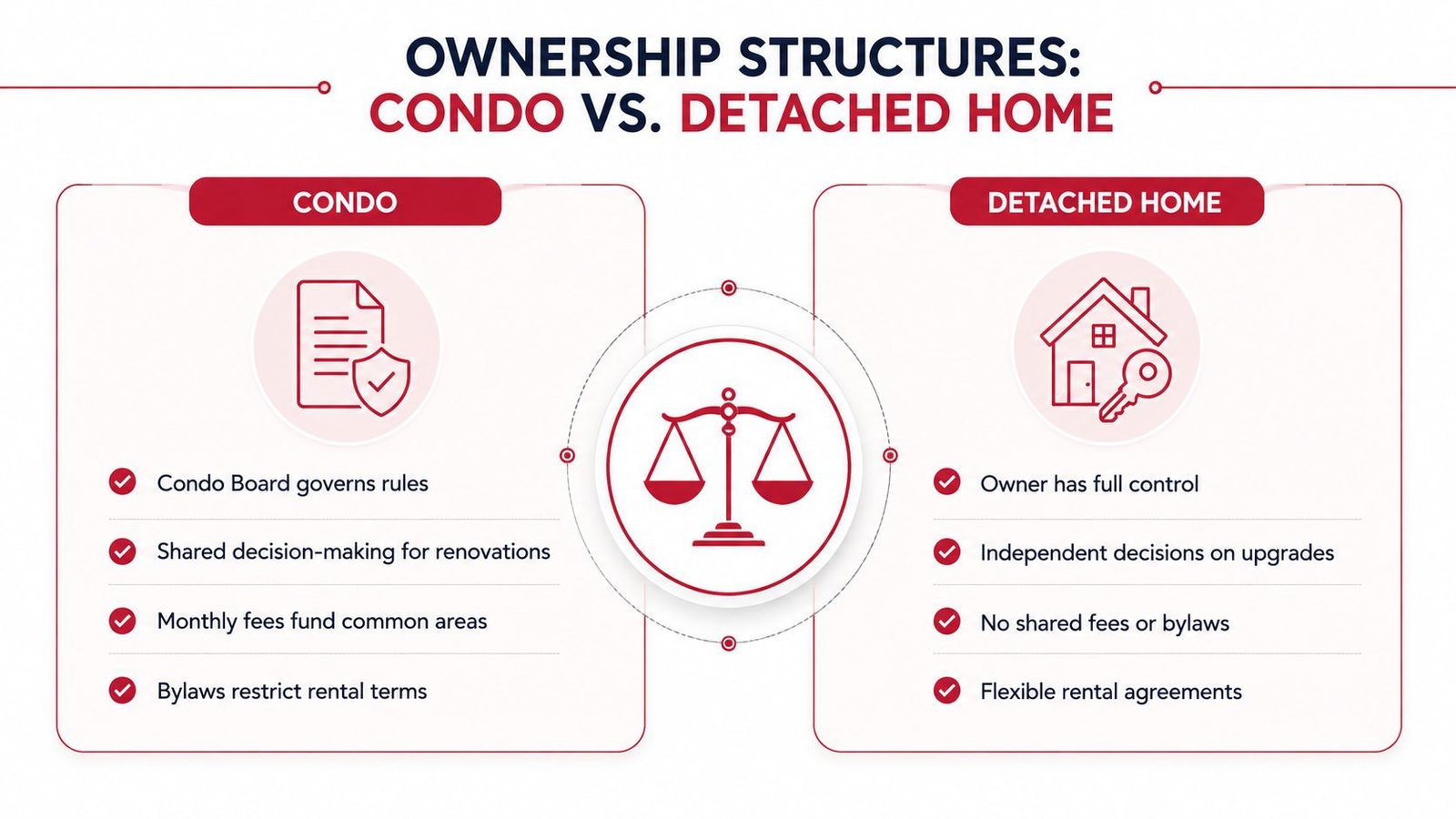
Condo ownership in Alberta is not just a different property type, it's a different legal structure. Under the Condominium Property Act, the owner holds title to a private unit and an undivided interest in the common property. That means the owner does not control the whole asset the way a detached-home owner does. The condominium corporation, through its bylaws and rules, governs part of the operating reality.
That structure matters the moment a landlord wants consistency. Renovation timing, pets, parking, use of common areas, and rental policies can all be shaped by the corporation's rules. A detached-house owner can usually make those decisions directly, subject to municipal rules and tenancy law. A condo landlord has another decision-maker in the middle.
A good condo investment behaves like a partnership in the operating sense, even when the title is private.
The practical difference is control. A house gives the owner more freedom over upgrades, tenant arrangements, yard use, and maintenance timing. A condo gives the owner less room to act unilaterally, but often more access to building-level systems that reduce hands-on exterior management. Neither is automatically better. The question is whether the governance layer fits the owner's operating style.
For remote owners, that governance layer can be a double-edged sword. It can improve predictability when the building is well run, but it can also slow decisions when the board, manager, or bylaws are rigid. The best Alberta landlords review the corporation documents before closing, not after a tenant is in place. That habit prevents a lot of avoidable friction, especially when a unit's rental plan depends on fast turnarounds or flexibility around improvements.
Monthly Cash Flow and Operating Cost Analysis
Cash flow comparison is where many condo-versus-home decisions become clearer. The mistake is to compare purchase price and stop there. Alberta investors need to compare the full monthly stack, because the way costs are packaged changes both risk and predictability.
How the monthly stack behaves
| Cost Category | Condo | Detached Home |
|---|---|---|
| Mortgage payment | Often lower because the purchase price and loan balance may be lower | Often higher because more capital is tied up in the asset |
| Condo fees | Monthly operating cost, usually part of the standard carrying cost | No condo fee, but no shared pool for common costs either |
| Property taxes | Apply in both cases | Apply in both cases |
| Insurance | Shared insurance structure may reduce some direct exposure, but owner still needs proper coverage | Owner bears the full direct insurance responsibility |
| Repairs and maintenance | Some building items are covered through fees and reserves | Owner funds repairs directly, often at irregular intervals |
| Reserve-fund exposure | Important to review, because weak reserves can create special assessments | No reserve-fund assessment, but major repairs can still be expensive and sudden |
The operating difference is simple. Condo fees turn some repair volatility into a scheduled expense. Detached homes keep more flexibility, but the owner absorbs more surprise work. For a landlord trying to forecast net operating income, predictability has value, but only if the fee is justified by the building's condition and reserve health.
That is where reserve-fund review becomes essential. A weak reserve plan can turn a seemingly stable condo into an unstable one very quickly. Special assessments can damage cash-flow projections because they arrive outside the normal underwriting rhythm. A house can also surprise an owner, but the condo owner is often exposed to both the unit and the corporation's governance decisions.
The management side matters too, especially for owners comparing property management costs against self-management. Property management fee structures often look expensive until they're compared against the time, turnover, and compliance load of handling a unit alone. In both condos and homes, the core question is not whether there's a cost. It's which cost is more controllable.
Bottom line: condos often trade repair volatility for fee volatility, while detached homes trade fee volatility for repair volatility.
Tenant Demand and Rental Performance in Alberta Markets
Tenant demand in Calgary and Edmonton does not behave the same way for condos and houses. Condos usually attract renters who want location, simpler upkeep, and lower commitment to yard or exterior care. Detached homes tend to attract families and longer-term tenants who value space, privacy, and more control over day-to-day living.
That difference affects turnover. A condo near transit, employment nodes, or strong amenity corridors can lease well because it fits the needs of single professionals, couples, and smaller households. A house in the right school catchment or family neighbourhood can command a different type of tenant, often one who stays longer and treats the property more like a long-term home. Those are different business models, even if the rent rolls into the same bank account.
What tends to work in practice
- Well-located condos: These often lease best when the building is clean, the rules are sensible, and the suite feels easy to maintain for a busy renter.
- Detached homes with functional layouts: These tend to perform when families can see stable parking, storage, and private outdoor use.
- Amenity-heavy buildings: These can help a condo compete, but only if the condo fees don't push the owner into a weak net position.
- Plain, well-kept homes: These often win on tenant quality because they offer autonomy and reduce friction around pets, noise, and lifestyle fit.
The rental market also rewards properties that are easy to understand. If a condo building's bylaws are unusually restrictive, tenant interest can narrow. If a house needs constant upkeep, the workload can narrow the owner's profit margin. The best-performing property is usually the one that matches its tenant profile without creating avoidable rules or upkeep headaches.
A landlord choosing between condos and homes in Alberta should think in terms of net operating stability, not just gross rent. The property that fills faster is not always the property that performs better after vacancy, maintenance, and compliance. That distinction matters most in markets where renters have more than one option and owners are trying to protect cash flow, not just occupancy.
Compliance and Property Management Considerations
Alberta rental compliance starts with the Residential Tenancies Act, and both condos and detached homes must follow it. That includes proper notices, deposit handling, records, and the timing rules around rent increases and terminations. The difference is that condo landlords also have to manage the corporation's rules, so one property can sit under two operating frameworks at the same time.
The practical effect is simple. A house landlord usually deals with the tenant, the municipality, and any vendor directly. A condo landlord may also need to coordinate building access, move-in rules, elevator bookings, renovation approvals, and bylaw compliance. That extra layer is why condo management can become more administrative than many owners expect.
The rent-increase rules matter here because landlords can't treat timing casually. Alberta's general framework requires 12 months between rent increases, along with specific notice periods. That makes documentation and calendar control important for both condos and houses, but it becomes even more important when a condo board or building manager also has timing expectations around access, notices, or unit use. Alberta landlord and tenancy compliance guidance is helpful for owners who want those timelines managed without guessing.
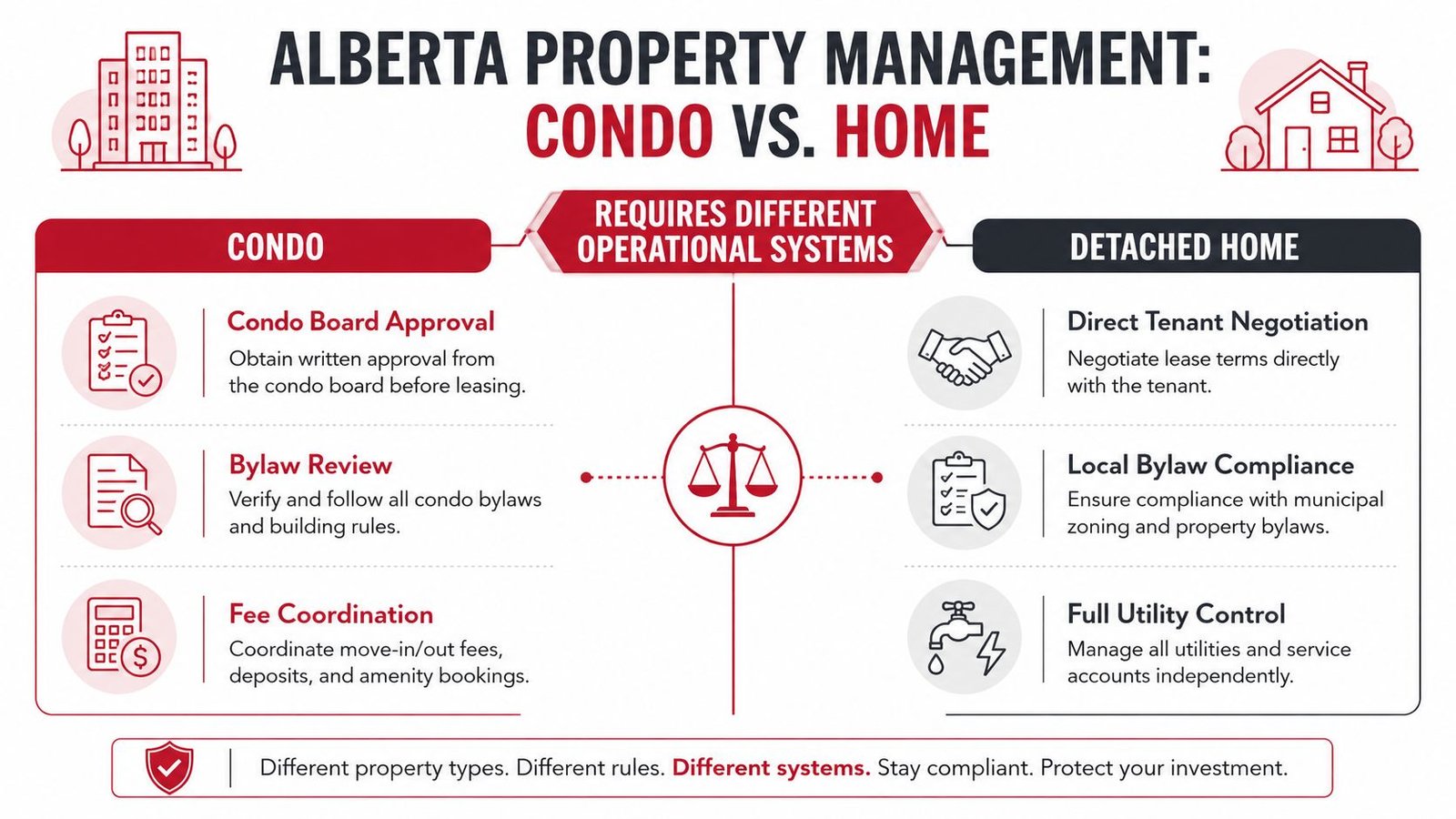
For remote owners, professional systems pay off. A good manager keeps notice periods, inspections, repair approvals, and documentation in one process instead of treating each property as a one-off exception. That consistency protects owners from disputes and reduces the kind of errors that happen when a landlord is juggling tenant communication and corporation rules at the same time.
Investment Returns and Long-Term Value Factors
The long-term return case for condos and detached homes comes from different sources. Detached homes often carry more upside tied to land value and lot scarcity. Condos, by contrast, tend to optimise capital efficiency, because the owner usually takes on a smaller mortgage balance and less direct land exposure.
That difference matters across market cycles. A detached home can benefit when land becomes harder to replace in a neighbourhood. A condo can still perform well when demand is concentrated around transit, employment, or affordability pressure, but the value driver is more dependent on building condition, governance quality, and market acceptance of the specific project. Building quality matters more than most sellers admit.
There is also a depreciation reality that investors should not ignore. A house owner can control more of the asset, but also carries more of the upkeep burden. A condo owner may have lower friction in some areas, but the building itself ages as a shared asset, which means poor reserve planning can become a drag on value. In other words, condos and homes don't just grow differently, they age differently.
For Alberta investors, the better question is not which type appreciates faster in the abstract. It's which type fits the planned hold period, the owner's tolerance for governance, and the exit strategy. A condo can be a smart capital-preservation tool when the goal is efficient entry and manageable debt. A detached home can be the stronger long-horizon wealth builder when the owner can handle more maintenance and wants more direct control over the asset.
Making the Right Choice for Your Investment Strategy
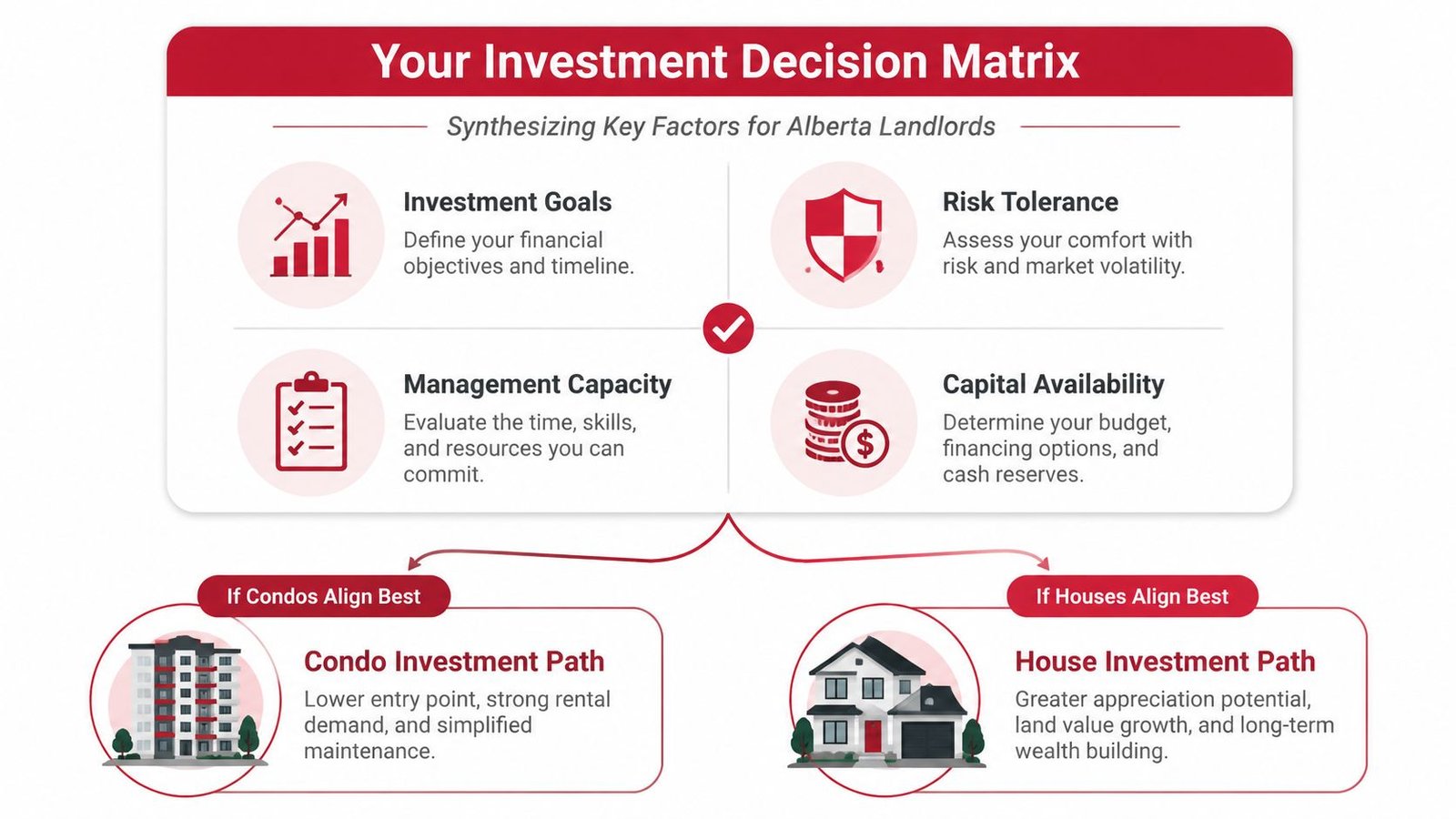
The best choice depends on the investor's operating style as much as the budget. A first-time landlord who wants cleaner entry economics and less direct repair exposure may find a condo makes sense. An experienced owner who wants control, land value, and fewer shared-rule complications may prefer a detached home.
That choice becomes clearer when the property is matched to the underlying business model. A condo often wins when the unit is easy to lease, the fee structure is sane, and the corporation is well governed. A house often wins when the neighbourhood supports stable family tenancy and the owner can absorb maintenance without disrupting cash flow. Neither asset performs well when bought on hope instead of numbers.
A simple decision filter
- Choose a condo when: the building is well maintained, the fees are understandable, the reserve fund is healthy, and the likely tenant profile fits urban rental demand.
- Choose a detached home when: control matters more than convenience, the owner can handle repairs directly, and the land component justifies the higher operating burden.
- Avoid both when: the numbers only work with optimistic rent assumptions or the owner cannot tolerate surprises in the monthly stack.
The right property is the one that can survive a realistic vacancy, a normal repair cycle, and a full compliance review without breaking the plan.
An Alberta landlord should also assess the management load before buying. If the property sits in a condo corporation with active rules and frequent coordination needs, the operational burden can be more intense than the purchase price suggests. If the property is a house with aging systems and no shared reserve cushion, the repair burden can be just as demanding in a different way.
Dreamhouse Realty Ltd. helps Alberta landlords sort out these trade-offs before a bad assumption becomes an expensive vacancy, a compliance issue, or a cash-flow surprise. If the next purchase needs clear underwriting, local leasing support, and day-to-day management that fits Calgary and Edmonton realities, visit Dreamhouse Realty Ltd. and connect with GURIQBAL CHAHAL, MBA, PMP, REAL ESTATE BROKER, Phone 403-966-6072.